St. Colman's Day
Cobh
24 November 2026
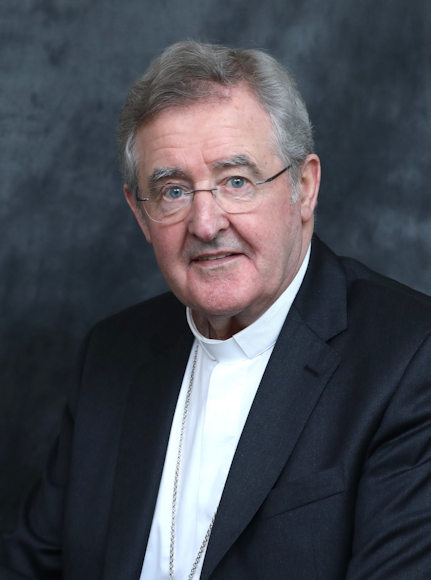
Homily by Archdeacon Cornelius O'Donnell
My dear people of God and friends of St. Colman.
24th day of November is a very special date for us as we celebrate the feast of our great founder and patron, St. Colman, in this beautiful cathedral of St. Colman.
I think this is only the second time in my life speaking in this magnificent cathedral – the first was about sixty years ago when I gave a homily as Gaeilge on St. Patrick’s Day. Fr. John Warren was the Administrator, I was visiting the schools, I was staying with him and enjoying his hospitality for a week, so I couldn’t say no. Bishop Ahern, who was presiding at the Mass told me go raibh me go hiontach. Of course that time one spoke from the pulpit halfway down the church and there was no microphone, so I was assured by Fr. Warren afterwards that Bishop Ahern didn’t hear a word I said.
From my earliest years, this day was very special for us as boarders in St. Colman’s College in Fermoy. We had a ‘free day’ – no class or study - a welcome break midterm. The priests of the deanery were invited in for a special dinner; we entertained them and they entertained us, and we applauded with counterfeited glee as they recited or sang their party pieces.
I well remember Fr. John Finn, then a curate in Conna, with his ‘bridle hangin on the wall’.
St. Colman was born in the year 530. That was less than seventy years after the death of St. Patrick in 461. It is extraordinary and amazing that in that short time the Christian faith had taken root in the lives of so many people. It was a time of extraordinary education and scholarship, bringing together all the pre-Christian oral tradition of story and poetry, and a new era of monastic life began to emerge with literacy and literature, history and scripture, with the study of Latin and Greek, epic songs and stories.
Colman, we are told, was a Royal Bard at the court of the King of Munster at Cashel. As a bard he would have been responsible for composing poems of praise, (panegyrics they called them), in praise of the king and preserving the royal lineages and events. In fairness, a bard was on a lower rung of the ladder on the journey to be a poet – a real poet, a ‘file’. To become a ‘file’, one would have to study for up to ten years or more, able to retain, memorise and recite up to 500 ancient poems and stories.
Luckily for Colman he met a Kerry man, another learned man from Tralee – Brendan of Clonfert. It is thought that Colman would have been maybe 50 at the time. Brendan persuaded him that while he had sung the praises of an earthly king in Cashel, he should now turn a new leaf and start praising the eternal King of Kings. So Colman was baptised, and as a late vocation studied for the priesthood, learning to get to know and love Jesus Christ. During that time, he became that ‘file’, a real poet, going through that highly regimented programme and rigorous training. Colman is recognised as one of the earliest poets to write in the vernacular Irish using the Latin alphabet.
We mentioned Brendan of Clonfert. Around that time there were lots of monastic sites and great schools of learning emerging around Ireland. Skellig Mhichil off the coast of Kerry, St. Kevin in Glendalough in Wicklow, Kieran in Clonmacnoise in Offaly, Finnian of Clonard. Comgall in Bangor in Co. Down. Of course we had Finbarr in his cell in Guagan Barra.
We can only imagine that Colman set up something similar in his cell and school in the village of Cloyne, preaching, teaching, learning, writing, praying – singing the praises of God, attracting the people to come and hear the Good News.
During this time there was another movement taking place.
In Bangor, where there were hundreds of monks, it was decided to build a boat, a currach, a naomhog, with a mast and sail and oars. Thirteen of them were chosen – to head out into the open Irish Sea with all the supplies they could carry, Columbanus and his anam cara Ceallach, known later by his Latin name of Gall, and eleven others in that small boat. It was a kind of martyrdom, pereginatio pro Christo, pilgrims for Christ. They would call to Bangor, the monastery in North Wales for fresh supplies for the voyage, but they had a longer journey to make, around Cornwall, arriving in Brittany, making their way to the monastery in Landevennnec which had already been established some years previously by St. Guenole. There is a Benedictine monastery there to this day. It is likely that our Irish travellers spent a year there in Landevennec before moving on. Sailing the rivers, the Loire, the Rhine or trekking the Roman roads of ancient Gaul, founding at least three monasteries on the way, somehow, they reached Lake Constance in Switzerland, and set up the famous monastery, called after Gall himself – Saint Gallen. Columbanus would leave his friend Gall in St. Gallen and move on over the Alps to Bobbio, building his monastery in a valley in the Apennines in the north of Italy. The ancient and famous manuscripts found in St. Gallen and in Bobbio were written on vellum that came from the hides of cows in Ireland and the indelible and waterproof ink from the bark of the oak and blackthorn of the Irish countryside.
To get back to Cloyne, St.Colman died in 606 at the age of 76. St. Columbanus, whose feast we celebrated yesterday, would outlive him by nine years. Their legacy throughout Europe lives on, the legacy of faith that has inspired the generations for fourteen hundred years. That faith has been handed on to us in spite of conquest, famine, persecution, penal laws. Catholic religion was banned, churches confiscated, catholic clergymen proscribed, imprisoned and punished even with death. It is no wonder that the see of the diocese of Cloyne was vacant on many occasions. The Dioceses of Cork and Cloyne were united for three hundred and twenty years up to the death in 1747 of Dr. Teige McCarthy, the last bishop of the combined dioceses of Cork and Cloyne.
I have a special interest in one bishop in particular, the bishop who succeeded Bishop McCarthy in the separate Diocese of Cloyne the following year 1748 – Bishop John O’Brien. He lived in Cloyne for a while, but, with his life in danger, went into hiding in a remote glen in Ballinterry just outside the village of Rathcormac, the parish where I have spent a third of my life. A remarkable man, one of the most eminent and learned bishops in the long line of successors of St. Colman, the author of numerous poems and works of Irish historical subjects, and the compiler of an exhaustive Irish-English dictionary, one of the first of its kind. From his hideaway in Ballinterry, and with the local member of parliament Abraham Devonsher of Kilshannig turning a blind eye, or even supporting him, he travelled in disguise around the diocese carrying out his duties as a bishop. He eventually fled to France, an exile for the faith. He never returned, died at Lyon in the south of France 13th March 1769. His tomb in the church in Lyon was destroyed in the French Revolution twenty years later and no trace of it now remains.
We have outlived those difficult times, but no era of the Church is without some form of persecution. The song says: ‘when will we ever learn, when will we ever learn’? Today we have Nigeria, Myanmar, Pakistan, the Holy Land and many more, all crying out in agony. Only last week we were reminded that this persecution of Christians has intensified, the worst ever in the history of the Church, while much of the world is silent.
Today, we have many new and diverse challenges. But there are 1.4 billion Catholics in the world, 5,500 bishops ready to live and even die for Christ. God is greater than any crisis. We constantly hear: Don’t be afraid. Launch out into the deep. We trust in God and move on and let God be God. Only in the darkness of night can we see the distant stars. The Good Shepherd is there with crook and staff. We, the followers of Christ, are always people of hope.
Bishop William’s motto is “croi le bri nua”. On this feast of St. Colman, may we go forward in our synodal church le chroi agus le bri nua and we need fear no evil. St. Paul, towards the end of his life encouraged his great friend Timothy to fan into a flame the gift that God had given him. “You have been trusted with a wonderful treasure. Guard it with the help of the Holy Spirit who lives in you”. (2 Timothy 1:14) You and I, dear friends, have been entrusted with a great treasure by our patron, St. Colman. Guard it with the help of the Holy Spirit.